 Plexara
Plexara Research · The graph-completion study
What connected knowledge buys the agent that has to be complete: voluntary traversal, flat discovery cost, and a pre-registered kill on the public record
Plexara, a product of Deasil Works · 2026-08-10 · Client: Claude Code 2.1.225 and 2.1.226 · Data and code: txn2/mcp-data-platform · Frozen design: pre-registered before any episode ran · DOI: 10.5281/zenodo.21881798
Abstract
Plexara’s knowledge pages reference the pages that govern them, and this study measures what those references are worth to an agent that has to produce a complete document rather than answer a question. Across a premise probe and a confirmatory matrix that grew the corpus from 50 to 5,000 pages around byte-identical tasks, agents on the connected corpus grounded every constraint in every condition, reading as little as 0.2% of the largest corpus. The references did not change what the finished document contained; competent search reached the same content. They changed what it cost, holding search effort per constraint flat across two orders of magnitude of corpus while the stripped arm’s effort roughly doubled and produced the matrix’s only failed episode, and they were the only route that worked when search was off or the reading budget was small. One pre-registered construct, semantic discontinuity, died by its own kill condition: prose that preserves a page’s meaning hands a competent searcher the vocabulary to find it, so the certified unreachability the construct required cannot be authored. We publish the kill with the result.
This page presents the results with commercial framing. Citing this research? Cite the brand-neutral report published in the open-source project, archived with its raw data on Zenodo under DOI 10.5281/zenodo.21881798; the report’s citation section gives the suggested citation and BibTeX.
1. The question a ranked result list cannot answer
The accuracy study measured what a knowledge layer is worth on questions, and the knowledge-use and knowledge-pollution studies measured whether agents act on delivered facts and what a wrong one costs. A question has an answer. A change plan does not; it has a completeness bar. It is done when every governing constraint is in it, and missing one is not a lower score, it is a freeze window nobody observed.
Search is the wrong shape for that bar. A ranked list returns some relevant pages and certifies nothing about the ones it did not return. Plexara’s knowledge layer is connected: pages reference the runbooks, calendars and registers that govern them, so there is a second discovery structure available, following the references. This study measures what that structure buys, on tasks where being almost complete is failing.
2. Method: completion tasks over a generated wiki
Three completion cells, each a document an operations team actually writes: a schema change plan for a governed data stream, an incident-handling write-up, and the onboarding of a new nightly data feed. Each cell’s governing constraints live on 5 to 8 pages spread through an operations wiki, up to four references deep from the entry page the agent is handed. Every constraint carries a hard token that exists only on its source page, so grading is deterministic: a constraint counts as grounded only when its token is in the final document and the source page was actually fetched during the episode. A token in the document with no read behind it is counted separately, as fabrication.
Two corpora with the same prose meaning: a connected arm, where pages reference each other the way Plexara knowledge pages do, and a stripped arm, where each reference is rendered as its plain-prose fallback sentence instead of a link. Crossed with search on or off, and run at three corpus sizes, 50, 500 and 5,000 pages, generated deterministically from a recorded spec so any reader can regenerate the exact corpus. The three cells and their 27 core pages are byte-identical at every size; only the haystack grows. The matrix, the dependent variables and the kill conditions were frozen in a design document before any episode ran.
The premise probe ran 72 episodes on a 42-page corpus at two reading budgets. The confirmatory matrix ran 99 pre-registered episodes across the three sizes with one agent configuration, moving the ratio of reading budget to corpus size two orders of magnitude. One episode died to a harness error and is archived as such, not graded.
3. Results: agents follow references unprompted
Hand an agent one entry page, no search tool, and a task whose constraints sit up to four references away, and it walks. On the large reading budget the agent recovered 96% of the spread constraints by pure reference-following, at zero queries, reaching the deepest page of every cell in all nine episodes. The small budget recovered 42%, and its failures were stopping early, not failing to start. On the stripped corpus the same agents recovered nothing, because nothing gave them a route.
| Corpus | Search | Reading budget | Grounded coverage | Fabricated slots | Reads per episode | Searches per grounded constraint |
|---|---|---|---|---|---|---|
| connected | off | large (opus alias) | 0.96 | 0 | 9.0 | no searches |
| connected | off | small (haiku alias) | 0.42 | 0 | 4.6 | no searches |
| stripped | off | large (opus alias) | 0.00 | 13 | 6.0 | no route |
| stripped | off | small (haiku alias) | 0.00 | 1 | 0.7 | no route |
| connected | on | large (opus alias) | 0.99 | 0 | 19.0 | 0.57 |
| connected | on | small (haiku alias) | 0.29 | 4 | 2.4 | 2.30 |
| stripped | on | large (opus alias) | 1.00 | 0 | 21.1 | 0.64 |
| stripped | on | small (haiku alias) | 0.10 | 3 | 1.0 | 8.00 |
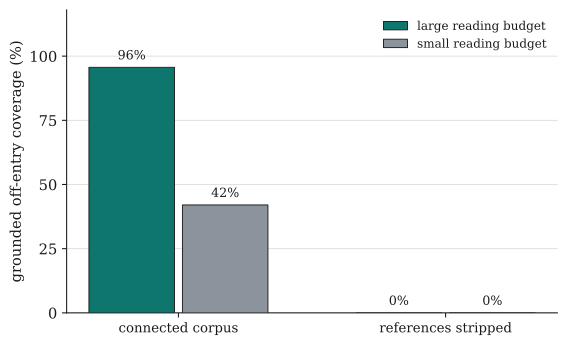
The walk survives scale. In the confirmatory matrix’s no-search condition at 5,000 pages, every episode was a full-depth pure-reference walk: 9 reads per episode, which is the size of the reference closure itself, every constraint grounded, all nine episodes. Voluntary traversal is not an artifact of a small corpus.
4. Results: at scale, references change the cost, not the content
With search on, both corpora reach the same place: grounded coverage is at ceiling in every cell of the matrix. At 5,000 pages an episode makes about 11 reads, roughly 0.2% of the corpus, and still grounds every constraint. Discovery is not enumeration; targeted search plus the vocabulary an agent picks up from the pages it reads collapses a 5,000-page haystack as effectively as a 50-page one. What scale moves is the cost.
| Pages | Corpus | Search | Episodes | Grounded coverage (SD) | Reads per episode | Searches per grounded constraint | Reads found via references |
|---|---|---|---|---|---|---|---|
| 50 | connected | on | 15 | 1.00(0.00) | 15.3 | 0.59 | 0.09 |
| 50 | stripped | on | 15 | 1.00(0.00) | 16.1 | 0.73 | 0.00 |
| 500 | connected | on | 15 | 1.00(0.00) | 12.3 | 0.67 | 0.28 |
| 500 | stripped | on | 15 | 1.00(0.00) | 13.3 | 1.02 | 0.00 |
| 5000 | connected | off | 9 | 1.00(0.00) | 9.0 | no searches | 0.89 |
| 5000 | connected | on | 15 | 1.00(0.00) | 10.7 | 0.63 | 0.34 |
| 5000 | stripped | on | 14(+1 failed) | 0.95(0.19) | 11.2 | 1.44 | 0.00 |
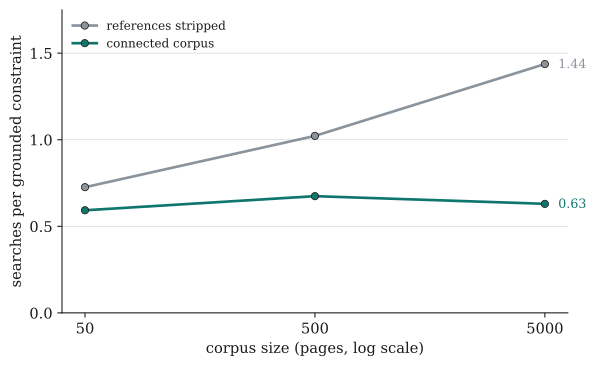
On the connected corpus the effort curve is flat: 0.59, 0.67, 0.63 searches per grounded constraint across two orders of magnitude. Stripped, it climbs: 0.73, 1.02, 1.44, plus the only failed episode and the only below-ceiling coverage in the matrix, both in the 5,000-page cell. And agents lean on the references more as the haystack grows: the share of reads discovered through a reference on a fetched page rises from 0.09 at 50 pages to 0.34 at 5,000, while the stripped arm stays pinned to search for every single read.
The 50-page cells are the built-in control: at a size where a raised search limit can enumerate the corpus, the design predicted no separation, and both arms sat at identical ceiling with a coverage delta of exactly zero. The separation that appears at scale is a scale effect, not a haystack artifact.
5. Results: under a small reading budget, references change the outcome
The probe’s small-budget arm is where references stop being an efficiency and start being the difference between a grounded document and a thin one. With search on, the connected corpus nearly tripled grounded coverage, 0.29 against 0.10, and cut the searches spent per grounded constraint from 8.0 to 2.3. The characteristic small-budget failure was searching without reading: in two thirds of its search episodes the agent issued queries, fetched nothing, and wrote the document from result snippets.
The durable variable is not the model, it is the ratio of reading budget to corpus size. The probe’s large budget could afford to read half of a 42-page corpus and hit ceiling with or without references; nothing can read half of a real knowledge base. As the corpus grows, every agent becomes the constrained one, which is exactly the regime the confirmatory matrix measured, and where the cost separation lives.
6. Results: coverage without reading is fabrication
The stripped no-search arm has a floor of zero by construction: the off-entry pages are unreachable. The large-budget agent still produced constraint tokens for 19% of the slots it had no way to read, 13 slots across nine episodes, stating plausible values inside otherwise accurate documents.
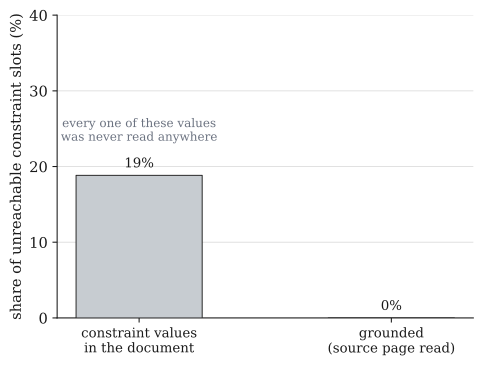
This is the completion-task face of the result the knowledge-use study measured on questions: starve an agent of a source and a confident value appears anyway. It is why every headline on this page is grounded coverage, token in the document and source page read, and why read provenance, not text overlap, is the only defensible way to grade a completion instrument.
7. The kill we published: prose is a search route
The confirmatory design pre-registered a stronger construct than cost. Six constraints were authored as semantic discontinuities, institutional obligations like a finance close calendar governing when a schema change may ship, written entirely in their own department’s vocabulary, never naming the task’s systems. Twice per corpus size, an offline embedding scan and a live sweep gate certified that no task-derived query ranked those pages. The claim under test: an authored reference crosses in one hop a gap that search cannot cross at all.
The stripped arms grounded those constraints anyway, at 1.00 coverage at 500 pages and 0.93 at 5,000. The design names any stripped-arm discontinuity grounding an instrument kill, so the kill fired and no confirmatory conclusion is read from those cells. What happened is worth more than the construct: the stripped corpus renders each reference as a meaning-preserving prose sentence, the agent reads that sentence on an ordinary page it found through search, and then searches again in the institution’s own vocabulary. It runs the traversal in query space, two hops instead of one.
The certifications were sound for what they measured; they measured queries derived from the task, and the defeating queries were derived from corpus text the agent had already read. Prose that preserves a page’s meaning necessarily names the institution, and naming the institution hands a competent searcher the vocabulary that closes the gap. An arm contrast that removed the mention would change what the page says and grade two different documents, which the design refused by construction. So the construct is not just unmeasured, it is unauthorable under a meaning-constant contrast, and we retired it rather than weakening the contrast to save it.
8. What this settles, and what it retires
- References do real work. Agents use them voluntarily, lean on them more as the knowledge base grows, and depend on them entirely when search is off or the reading budget is small. Connecting a knowledge page to the pages that govern it is not decoration; it is what keeps discovery affordable at the sizes real knowledge bases reach.
- The claim we make is the measured one. For an agent that searches competently, references did not change what the finished document contained at any tested size; they changed what it cost and how it degraded. We say that, rather than the grander completeness claim the kill took off the table.
- Grounded coverage is the reading that counts. The fabrication channel is real and measurable, so any completion claim, ours or a vendor’s, should be graded on read provenance, not on whether the right words appear in the output.
- What we did not learn. Whether agents know when they are done is unmeasured: no episode in 98 ever claimed completeness, so the overclaim channel never separated anything. And whether some constraint can be truly unreachable to read-informed search is a question our instrument cannot pose, for the reason the kill section states.
9. Reproducibility
Both run families are committed whole to the open platform repository: every manifest, graded attempt, transcript, gate reading and plant record, beside the frozen design document. Each family carries a stdlib-only analyzer that recomputes every number on this page offline, with no API key and no network. The corpora themselves are not stored; each archive records a spec and fingerprint from which the exact corpus regenerates, and the harness refuses on mismatch.
git clone https://github.com/txn2/mcp-data-platform.git
cd mcp-data-platform
python3 bench/reports/graph-completion/graph_tables.py   # every table
python3 bench/reports/graph-completion/figures.py        # every figure
The recompute is a build gate rather than a convenience: the project’s own verify step re-derives the headline numbers from the archives and fails on any drift from what the report prints, including the presence of the instrument kill and the archived analyzer’s deliberate non-zero exit. The analyzer exits non-zero by design: the pre-registered kill is present in the archives, and it refuses to bless kill-affected cells as confirmatory findings. That refusal is itself part of the published record, and this page reports those cells the same way. The report and a snapshot of the raw run data are archived on Zenodo under DOI 10.5281/zenodo.21881798, with a frozen PDF as part of the archive.
10. Limitations
- One agent client, and model aliases rather than resolved model identifiers: the archives record what the client was asked for (its small and large aliases), not a pinned model build. Budget-to-corpus ratio, not model identity, is the variable the design treats as durable.
- One authored corpus genre. Three hand-written completion cells inside a generated operations wiki, deterministic by construction; other document kinds and messier corpora are untested.
- Fifteen episodes per confirmatory cell resolves ceiling against collapse and a doubling of cost; it cannot resolve small differences, and nothing here claims finer resolution.
- The completeness-closure question is unmeasured, not answered: no episode ever claimed its document was complete, so the overclaim reading never separated the arms in either direction.
- The semantic-discontinuity cells are invalid by the pre-registered instrument kill and are reported as such; no conclusion about unreachable-to-search constraints is drawn anywhere on this page.
- The largest tested corpus is 5,000 pages. The cost curves justify no extrapolation beyond it.
- The tasks are posed and the corpus is authored; production agents on production knowledge bases are a separate instrument, not this one.
- Runs are pinned to recorded development commits of the platform, not a tagged release build, and the archives record the exact commit of each run.
11. References
- [1]Johnston, C. (2026). Does a Semantic Knowledge Layer Make an Agent Measurably Better? A Reproducible Benchmark. mcp-data-platform benchmark report series. link
- [2]Johnston, C. (2026). When Do Agents Use Stored Knowledge? Derivability, Capability, and the Limits of a Knowledge Layer. mcp-data-platform benchmark report series. link
- [3]Johnston, C. (2026). Knowledge Pollution: Verification Displacement, Capability, and the Price of a Curation Gate. mcp-data-platform benchmark report series. link
- [4]Graph-structured retrieval for query-focused summarization: builds the graph from the corpus rather than measuring authored references, and evaluates answer quality rather than grounded completeness. link
- [5]Knowledge-graph-indexed retrieval motivated by long-term memory consolidation; the retrieval structure is derived, and single-answer recall is the metric rather than document completeness. link
The rest of the research series
Each study in the series is published brand-neutral in the open platform project, archived with its raw run data under a citable DOI, and reproducible offline from the committed attempts. New studies join the series as they are published.

The accuracy study · 2026-07-18
Does the platform make an agent measurably more accurate on your data?
On questions that turn on a business rule, accuracy rose from 42.7% to 98.7%. A companion cold-start experiment taught a fresh install six facts one at a time and watched each question class unlock at its own lesson, and a lifecycle re-run measured a fact taught by one person being reused correctly by a different teammate 98.9% of the time.

The knowledge-use study · 2026-07-26
Does an agent actually use the knowledge the platform delivers?
Agents rely completely on delivered knowledge they cannot re-derive: conventions, definitions, policies. With the company definition delivered, confident fabrication fell from 75% to zero, and capable models re-verified every claim they could check.

The knowledge-pollution study · 2026-08-07
What does a wrong fact cost once it has cleared review?
A wrong fact never out-argued the correct source sitting beside it. It did something quieter: on a small model it suppressed the one query that would have refuted it, and every run that ran that query anyway answered correctly. The frontier-class models we run in production took the wrong answer zero times in 96 runs.
Everything here is inspectable
The design frozen before any episode ran, both run families with every transcript and gate reading, the corpus generator, and the analyzers that reproduce every number on this page all live in the open platform repository, including the instrument kill the analyzers refuse to gloss over.